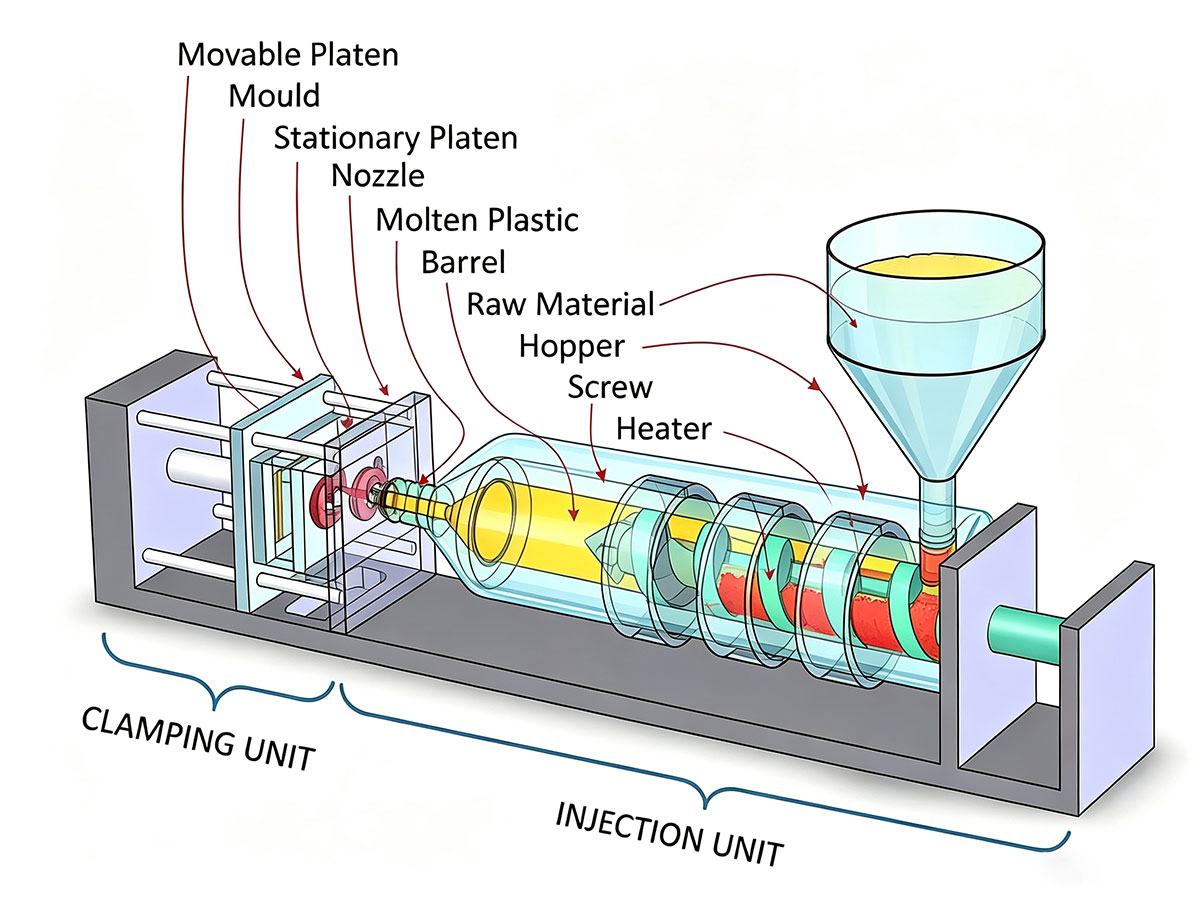
What is Plastic Injection Molding? – The Core of Winzun’s Expertise
At its essence, injection molding is a process where molten plastic is injected into a closed mold, then cooled and solidified to create precision parts. It is one of the most versatile and reliable manufacturing methods, delivering products with tight tolerances, stable performance, and low per-unit costs—making it the go-to choice for industries ranging from automotive and electronics to medical devices and packaging.
At Winzun, we have mastered this technology across a wide range of applications. With our advanced machinery, cleanroom facilities, and rigorous quality control, we turn molten plastic into durable, high-precision components that meet your exact specifications—whether you need high-volume production or complex multi-material designs. Injection molding is not just our process; it’s our promise of quality and efficiency.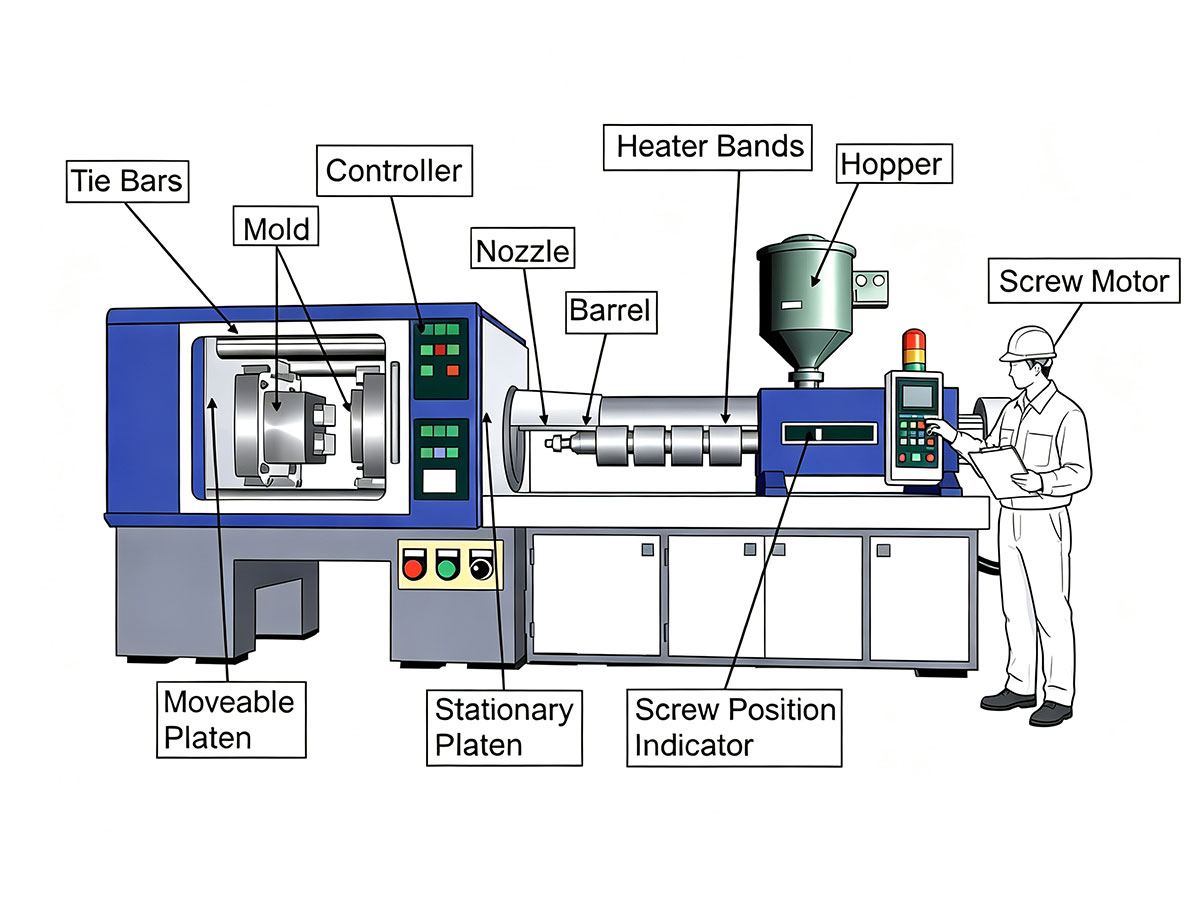
A Brief History of Injection Molding
The roots of injection molding trace back to the early 20th century, when pioneers first experimented with molding thermoplastics using cavity molds. As the plastics industry evolved and injection equipment advanced, the process matured into a high-efficiency, high-volume manufacturing method. A major milestone came in the 1960s with the integration of computer technology, which enabled automated control and precise regulation of process parameters. Today, injection molding stands as a cornerstone of modern manufacturing, powering innovation across automotive, medical, consumer goods, and electronics sectors.
Types of Injection Molding Processes
A. Standard Injection Molding
The most widely used process. Plastic pellets are melted and injected under pressure into a closed mold, where they cool and solidify to form the final part. This method excels in high-volume production due to its speed, repeatability, and dimensional accuracy.
B. Over-Molding
A process where a second material is injected over a pre‑molded substrate, creating a multi‑layer part in a single cycle. A typical example is adding a soft‑touch rubber layer onto a rigid plastic handle for enhanced grip and comfort.
C. Multi‑Component (Multi‑Shot) Molding
This technique produces parts that consist of multiple independent components in one molding operation, using separate cavities or sequential injections. It eliminates the need for post‑assembly, enabling complex geometries (e.g., multi‑material door handles) to be manufactured efficiently.
D. Micro Injection Molding
Specialized for producing tiny parts with features in the micrometer range. It requires ultra‑precise machinery and stringent process controls, and is widely used in medical devices, microelectronics, and precision mechanical assemblies.
E. Disposable (Single‑Use) Molding
Focused on producing single‑use products such as medical syringes, lab consumables, and certain packaging. While the process is similar to standard molding, it often emphasizes low cost per part and rapid cycles; however, due to the typical product life cycle, it may not always involve extremely high annual volumes, but can still be run efficiently with optimized tooling.
What is the Advantages and Disadvantages of Plastic Injection Molding?
Injection Molding Applications – Industries We Serve at Winzun
At Winzun, we bring decades of injection molding expertise to a diverse range of industries. Our comprehensive capabilities – from precision tooling and multi-material molding to cleanroom manufacturing and secondary finishing – enable us to deliver high-quality plastic components tailored to the unique demands of each sector:
Plastics & General Manufacturing – We produce custom-molded parts, containers, pipes, and fittings for industrial and consumer applications, leveraging our 80T to 1500T press range to handle projects of all sizes.
Automotive – From engine components and interior trim to structural parts and exterior body elements, our automotive solutions are built for durability, thermal stability, and exacting tolerances, meeting the rigorous standards of the industry.
Electronics & Electrical – We manufacture precision housings, connectors, sockets, and enclosures for electronic devices, with capabilities for flame-retardant materials, EMI shielding, and tight dimensional control – all backed by our Class 10K cleanroom options.
Medical & Healthcare – Our cleanroom facilities (Class 10K & 100K) and rigorous quality systems make Winzun a trusted partner for medical device components, diagnostic equipment parts, drug delivery systems, and sterile medical disposables, ensuring biocompatibility and consistency.
Packaging – We serve the packaging industry with high-speed, high-volume production of caps, closures, containers, and custom packaging solutions for food, beverage, cosmetics, and pharmaceuticals, offering precision, aesthetics, and cost efficiency.
Consumer & Specialty Products – From household goods and toys to sporting equipment and power tools, we help brands turn innovative designs into reliable, high-quality products that perform well in everyday use.
Whatever your industry, Winzun has the technology, experience, and commitment to deliver injection-molded solutions that meet your specifications – on time and on budget. Contact us to discuss your next project.
How Does the Plastic Injection Molding Process Work?
The injection molding process is a precisely orchestrated sequence of steps that transforms raw plastic pellets into finished components. Each stage must be carefully controlled to ensure product quality and consistency. Below is a breakdown of the standard workflow:
A. Material Preparation – The process begins with plastic pellets, the raw material for the final product. These pellets are accurately measured and conveyed into the injection molding machine via an automated material handling system, ensuring a consistent and uninterrupted supply throughout production.
B. Mold Clamping – The mold halves are securely closed and locked by the clamping unit of the injection machine. This step is critical to maintain mold integrity under high injection pressures, preventing flash or dimensional defects.
C. Injection – This is the core of the process. Under high temperature and pressure, the plastic pellets are melted into a fluid state. The molten polymer is then rapidly injected into the closed mold cavity. Key parameters at this stage – including injection speed, pressure, and shot volume – directly influence the part's quality, dimensional accuracy, and surface finish.
D. Packing & Holding – Once the cavity is filled, the packing/holding phase begins. The injection unit continues to apply pressure, compensating for material shrinkage as the plastic cools. This stage is essential to ensure complete cavity fill, enhance part density, and minimize sink marks or voids.
E. Cooling & Mold Opening – The molten plastic now cools and solidifies within the mold. Cooling time is determined by the material type, part thickness, and complexity, and must be optimized to achieve dimensional stability without sacrificing cycle efficiency. Once cooling is complete, the mold opens to prepare for part ejection.
F. Ejection & Part Removal – Finally, the solidified part is ejected from the mold using an ejection system, typically comprised of ejector pins or a pneumatic mechanism. The part is then removed, ready for subsequent operations such as inspection, trimming, secondary processing, or packaging.
Each of these steps is interdependent, and precise control at every phase is key to producing consistent, high-quality injection-molded parts.